
I never read the super famous YA series as a teen, and I’m really glad. I’ll get to why. I wasn’t hugely into the whole teens killing teens thing or the political stuff at that age, but there was more to it than that. My parents tended to guard my reading from many of the modern literature offerings that pervaded the market, and if everyone was obsessed with something, it was a pretty sure sign, from my perspective, that I wasn’t going to like it. I found that the things most of my peers were obsessing over were usually things I couldn’t morally support. The Hunger Games was no exception.
Now, as an adult and with a following built of readers who are looking for good books to read themselves or share with their kids—books that are safe for younger readers and have content they’re aware of, at the very least—I’ve gotten asked about The Hunger Games by a lot of parents. Below are my thoughts, my personal age recommendation, and a detailed content guideline (with page numbers) for each book. I’ll also share my opinion as a reader to share what I liked and didn’t like.
I hope this is a useful tool for parents who just want to cut through the fluff and get a good idea of what these books contain so they can be informed when giving it to their kids… or choosing not to.
The age range:
The Hunger Games is classified as YA, but recommended for ages 12+. It is often recommended by libraries and bookstores to middle grade readers due to its writing style and genre. This is somewhat concerning to me. I would NEVER recommend these books to youngsters, specifically to middle grade readers. I’m extremely glad I didn’t read it as a teen. I was a very sensitive reader, and I know for a fact that these books would have traumatized me.
My personal recommendation:
Teens 15+. Know your teen. Are they sensitive to animals or people dying? Does violence disturb them (as it should)? Not to make it a gender thing, but while boys might find these books more palatable, it’s possible that girls and sensitive children would find them too much in many aspects.
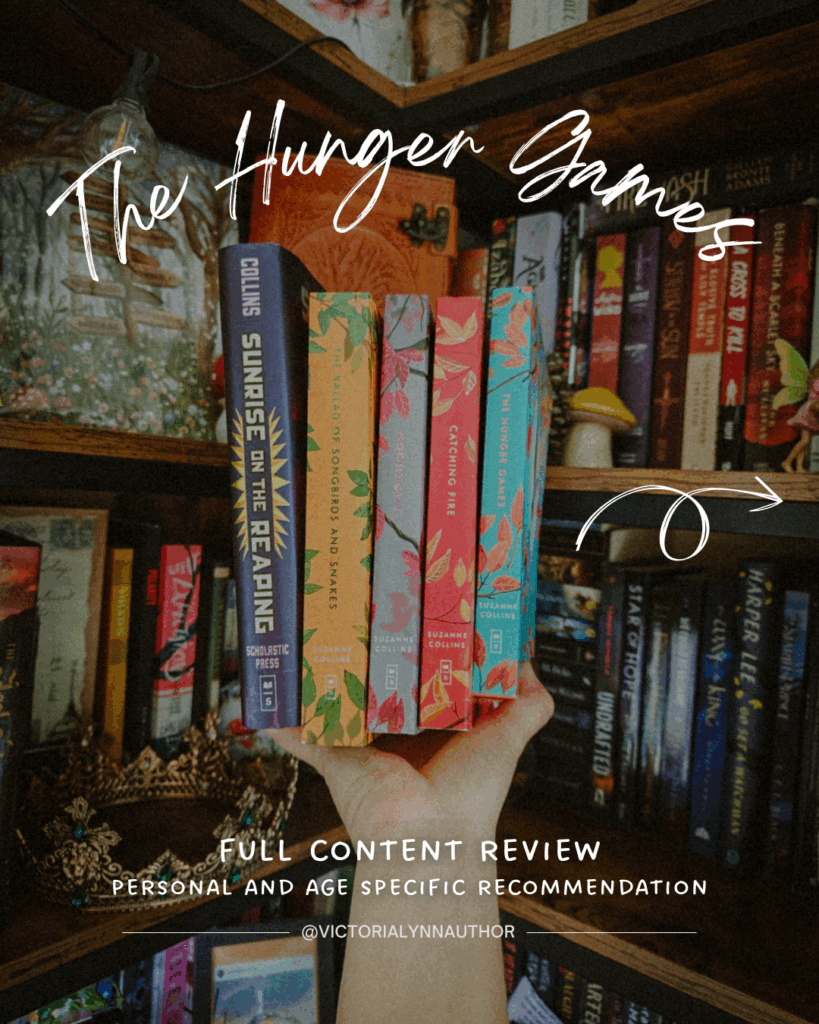
Content will be listed from the page numbers of the Scholastic special edition paperbacks you can find here. I will also list chapter numbers to help.
Spoilers ahead in the content slides specifically.
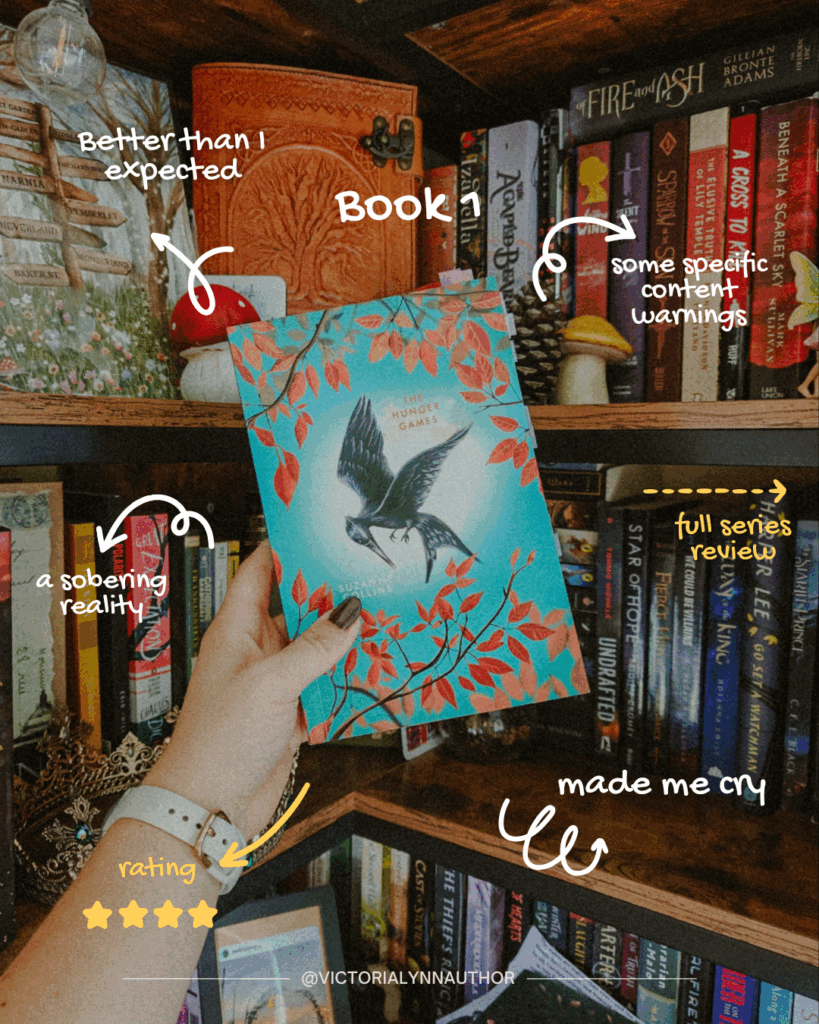
Book #1 :: The Hunger Games
My thoughts:
This book was well done and probably the easiest to read. I enjoyed getting to know Katniss as a character and learning what makes her an interesting heroine. The nature of her being an unreliable narrator, how her trauma informs her responses, and things like watching her interact with others and the confusing world of propaganda she has been fed as it unravels before her eyes wax extremely fascinating. The writing in this one was just really solid pacing wise and kept my interest. I see why it’s a modern classic.
Content:
Page 62 (beginning of chapter 5) – Nudity is mentioned as Katniss is disrobed in front of her prep team, one of which is a man.
Page 63 – Another moment where her stylist views her in the nude.
Page 264 (chapter 19) – Katniss helps bathe a wounded Peeta. She wonders at the propriety of him potentially being naked as she tends to him.
Page 256 – Another mention of Peeta being naked making her uncomfortable. He is not fully disrobed.
Violent content: Wounds are described, and there are many deaths, some of them particularly brutal in the arena. While Collins tends to be brief with deaths, they are often stark and bluntly put, which doesn’t always eliminate the extreme horror they can elicit.
Objectionable content: This book probably had the worst bit of disturbing content for me. At the end of the arena, mutts are released on Katniss, Peeta, and the remaining tribute. It’s unclear if these mutts were created from the dead tributes or simply made to look like them, but the descriptions alluded to the former, and it made me ill to read, even as an adult who is more used to violent content in my media. The way they were described, the emotional effect they had on Katniss, and the gore of the scene as they attacked the remaining tribute and tore him to pieces beneath the cornucopia was disgusting and highly disturbing.
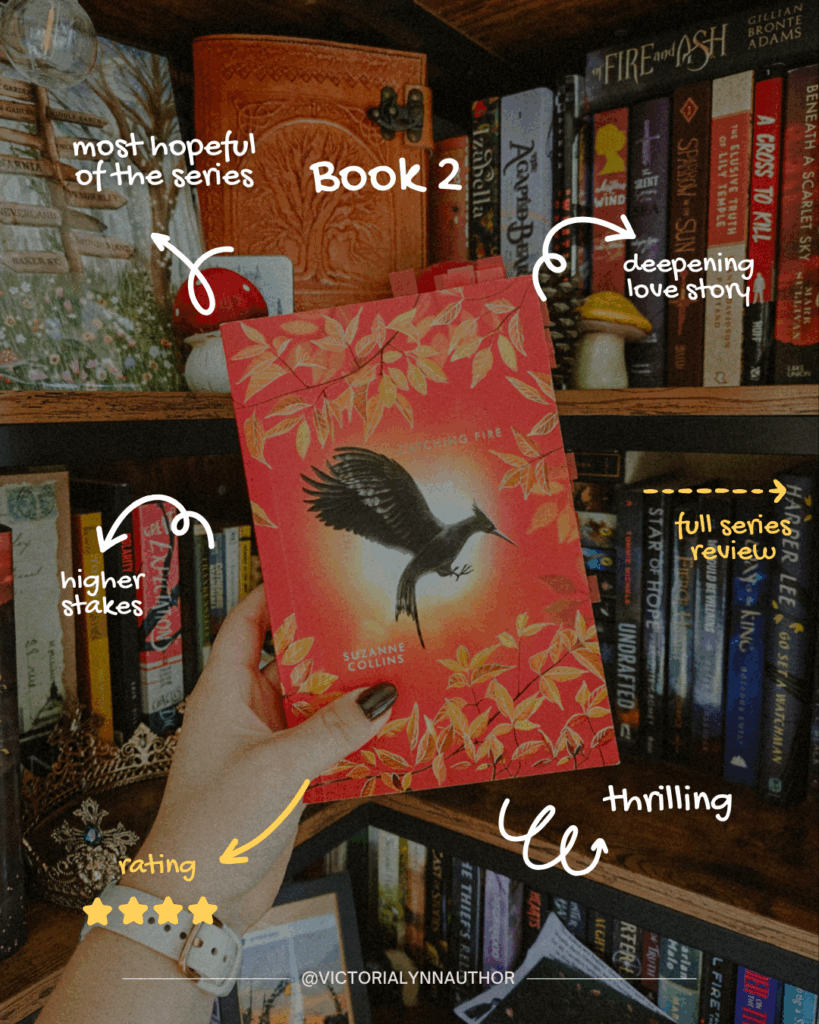
Book #2 :: Catching Fire
My thoughts:
This one might have been my favorite. It was extremely fast paced, and because of the nature of it being the second hunger games that Katniss and Peeta participated in, there were a lot of external motives. I think this book tends to be a bit lighter on the horrific elements because we feel a bit more removed from the detailed deaths and horror aspects that some of the other books play into. I enjoyed it the most from the standpoint of it being the least depressing of the series and the most interesting and fast paced as far as stakes go. The way that characters teamed up as well and had a stronger desire to work together infused a bit more hope into the narrative as a whole.
Content:
Page 27 – (chapter 2) Gale kisses Katniss and she seems taken aback and is unsure of what to think about the kiss.
Page 30 – (chapter 3) Katniss imagines President Snow drinking blood.
Page 49 – Katniss makes a comment in her inner dialogue about physical alteration like breast tattoos.
Page 72 – (chapter 5) Katniss and Peeta sleep together (not sex) after she has nightmares. It’s mentioned that they do this somewhat often as he tries to comfort her. It’s not mentioned in a sexual way.
Page 209 – (chapter 15) Finnick is described as a sensually attractive young man who is traded by the capitol for favors. It’s implied sexually and that he is promiscuous. It’s also mentioned that he’s as close to naked as possible with just his groin area covered.
Page 215 – (chapter 15) Joanna strips in front of Katniss, Peeta, and Haymitch in an elevator, wearing nothing but shoes.
Page 244 – Katniss and Peeta sleep together again (not sexually).
Violent content: Wounds are described, and there are many deaths, some of them particularly brutal in the arena. While Collins tends to be brief with deaths, they are often stark and bluntly put, which doesn’t always eliminate the extreme horror they can elicit.
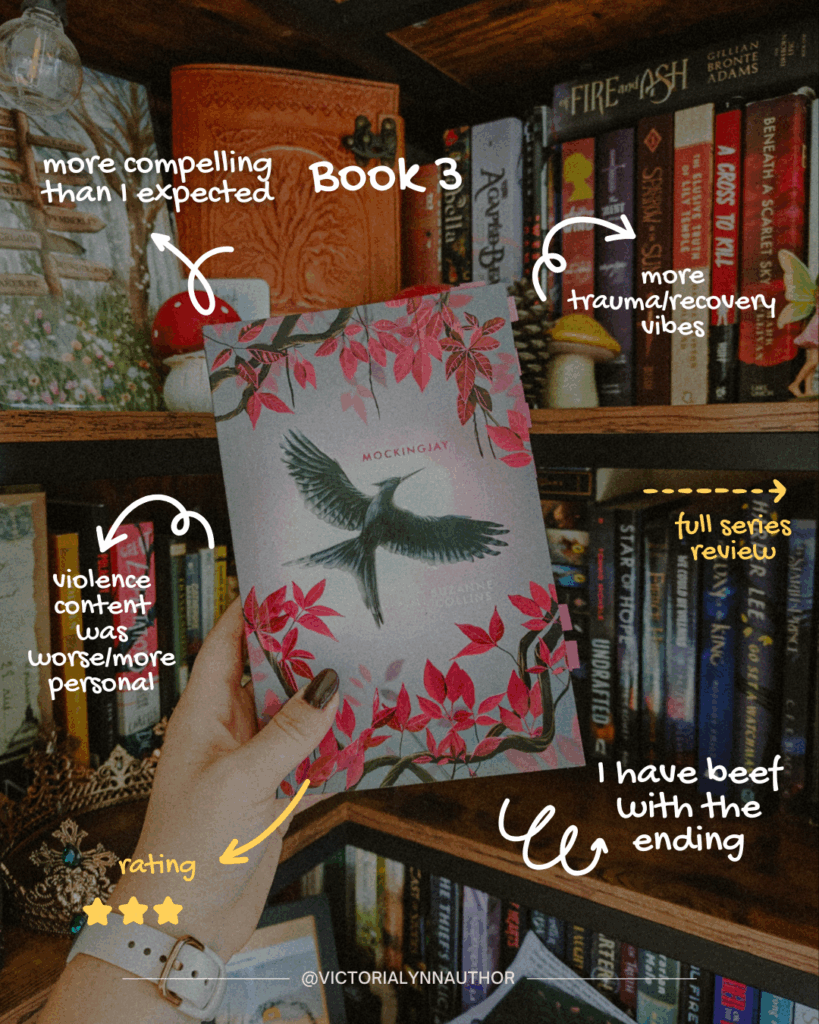
Book #3 :: Mockingjay
My thoughts:
This book was one of the heaviest as far as vibes go. Much of it is Katniss processing her trauma and unwinding some of the things that have made her lose trust in all of those around her. Relationships that she thought were solid all have some sort of turning point in this book that make her question if she can trust anyone. She even begins to question her own mind and her own perspective on things in a way that can be really heavy and disorienting. I did find it very interesting though because this is the book where Katniss truly unwinds the propaganda from both parties that has caused so much confusion and pitted people against each other. It’s also such a fascinating take on exploring the depths of your own mind and determining what makes something right or wrong for yourself and your soul, not just because a certain group says that it’s the right or wrong thing. I really loved watching Katniss come into her own in this way, and while this book was extremely heavy, that part of it allowed me to enjoy so much of the nuance and growth of Katniss’s internal struggles. I do have a bit of umbrage with the ending because I feel like allowing us to see more of Katniss’s growth in her motives would have benefited the narrative a bit more, but I also understand wanting to keep it ambiguous.
Content:
Page 198 – (chapter 14) Gale kisses Katniss somewhat intimately, kissing her neck and her mouth. She mentions how it makes her feel alive, and when finished, he asks her to kiss him. Gale makes a comment that because she can’t come to a decision on if she loves him or not that it’s like kissing someone who is drunk and that it therefore doesn’t count.
Page 274 – (chapter 19) Peeta details having to listen to and watch several people being tortured to death while in prison. They were burned, electrocuted, had pieces of their bodies cut off one by one, etc.
Page 308 – (chapter 22) A character is caught in a trap, and the group watches as his skin is melted off his body.
Page 312 – A beloved character is killed, and Katniss looks down as he screams to see him being ripped apart by the mutts. One of the more devastating deaths in the series.
Page 339 – (chapter 24) Katniss watches as people in a crowd are mowed down with gunfire. She focuses on a child that wails beside her deceased mother and then watches as the child is shot.
Page 341 – Katniss watches as people are killed by several traps, one of which induces extreme bleeding from bodily orifices. There are a lot of dead bodies, blood, and gore.
Page 346 – Children are bombed, and Katniss mentions several details about the horrors of seeding dismembered children.
Objectionable content:
Children being murdered, dismembered bodies, and a lot more gore exists in this book. It’s definitely one of the most depressing ones by far, and I don’t see how this can be an enjoyable read for anyone for those reasons. There are a lot more disturbing elements in this one simply because it feels like Katniss is no longer wearing blinders, and as we witness the story from her perspective, there is a lot more trauma associated with the violence throughout the book but specifically in the last half.
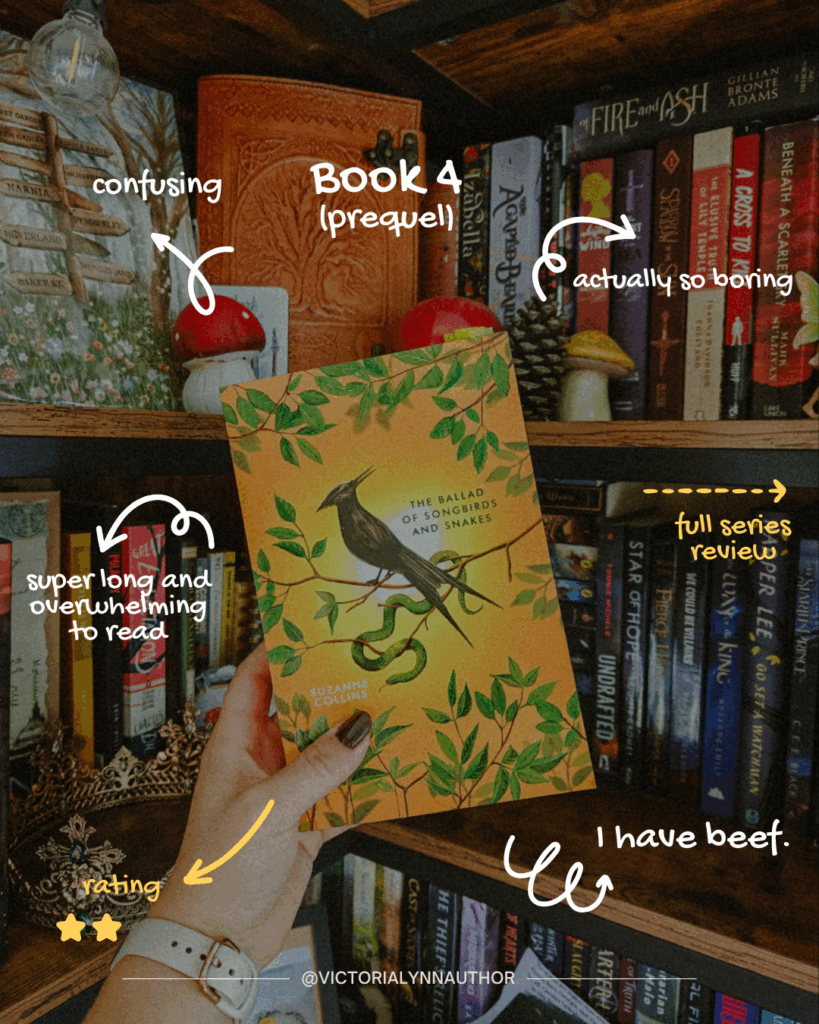
Prequel :: Ballad of Songbirds and Snakes
My thoughts:
I actually found very little to enjoy about this book. There was so much that I hated that it really detracted from things I might have liked. The best part for me was the Covey and some of the singing, but that was simply because I looked up the soundtrack, which you don’t fully get from the book on its own. While it was interesting at points, I found the story incredibly long, boring, and in use of a good slashing. The story could have been told in half the words and been more interesting. I don’t feel like the longer length, the fact that this story was told in third person vs first person, or the very decided style change in writing helped it become a better story in any way. Instead of seeing a devious, smart villain who is capable of rising to the top and holding the Capitol beneath his thumb for his entire life, Snow came across as a weak character who was always a victim of circumstances and saw himself as such. It didn’t make sense to me. To be someone strong enough to do what Snow did in being a master manipulator, you have to see something worthy in yourself, not just feel like a helpless bystander as you do things as if the decision has already been made for you. Lucy Gray and the Covey were interesting to me, but Snow made so little sense. Overall, I was extremely bored.
I would also say that the age range for this is definitely not middle grade and would be upper YA or adult in nature. It’s not written like a YA book in style or content, even if it doesn’t have any sexually explicit content.
Content:
Page 4 – (chapter 1) Snow thinks about how his cousin, Tigress, could easily be abused and sold for her body and that she could easily be wanted in an implied sexual way.
Page 31 – (chapter 2) Snow describes what it was like when most of the districts were starving and that he and Tigress as children had witnessed someone cutting off another person’s leg and eating it.
Page 99 – (end of chapter 6 beginning of chapter 7) Character slits another person’s throat, and we watch through Snow’s eyes as he tries to stem the bleeding. More on the gory side.
Page 115 – (chapter 8) A character is bitten by a lot of venomous snakes; pus drips down her hands, and she convulses at the poison.
Page 116 – Snow contemplates the creation of mutts and how humans have had animal parts surgically placed on them or vice versa. A rather disturbing paragraph.
Page 129 – (chapter 9) The body of a young girl, one of the tributes, is dangled from a crane hook, riddled with bullets, and eerily swings above the other tributes.
Page 205 – A brutally beaten tribute is hanging from manacles high above the ground.
Page 209 – (chapter 14) A tribute kills another helpless tribute with an ax, striking them multiple times at the base of the neck.
Page 311 – (chapter 20) A character falls and snaps his neck.
Objectionable content:
Mentions of cannibalism, more gruesome deaths, bluntly stated specifics of deaths, and definitely more gore in places. The first half is the worst in that department as once we are out of the games it gets better.
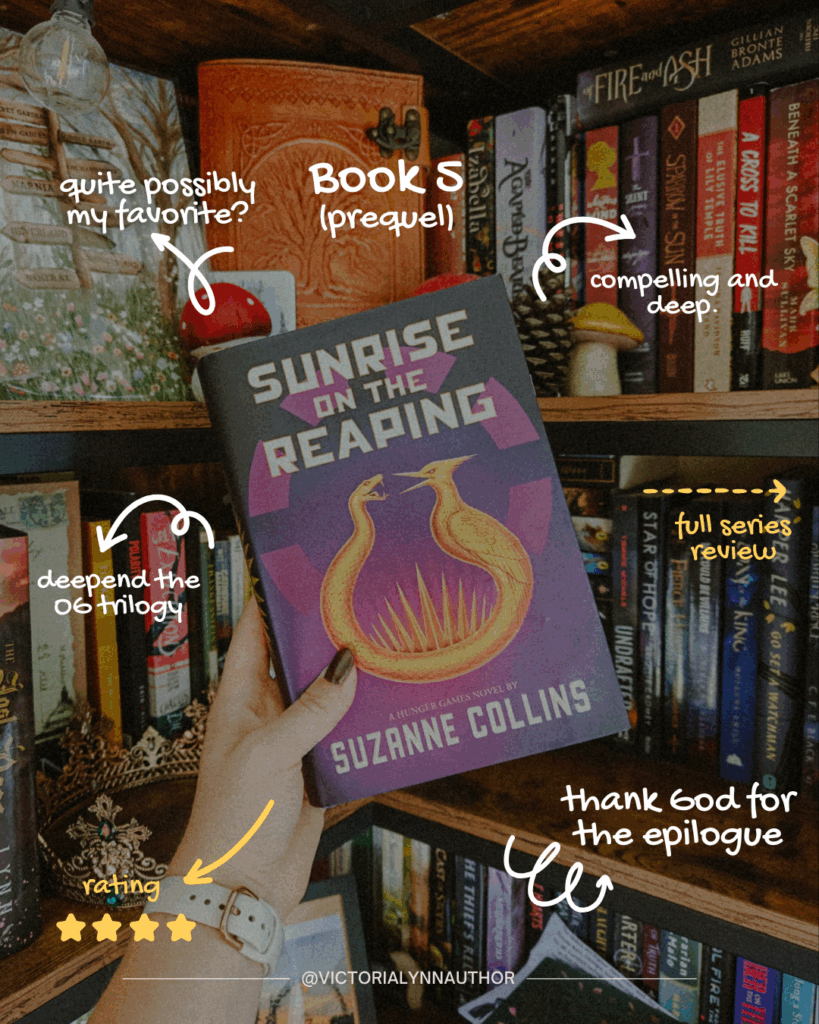
Prequel :: Sunrise on the Reaping
My thoughts:
I actually enjoyed this book. More than Ballads for sure. Haymitch’s story had the most hope of any of the books, outside of Catching Fire. There is something about the nature of having a conspiracy, something outside of yourself, to fight for, rather than just trying to survive, that made this book stand out. Haymitch is someone who isn’t supremely selfish, and his desire throughout the book to help others, make alliances with his friends from home, protect his girlfriend, and fight for other smaller and weaker tributes in the games made him very endearing. His mission within the games of trying to stick it to the Capitol, even if that meant sacrificing himself, gave us something to root for outside of survival and gave this book a touch of hope and sunlight in an otherwise depressing and bleak story and world. I also feel like the writing style returned to the usual more YA feel of narrative and prose that Ballads of Songbirds and Snakes diverged from.
Content:
Page 10 – Haymitch and his girlfriend kiss repeatedly. Not detailed or graphic.
Page 13 – It’s mentioned that Lenora’s uncle and guardian is probably gay.
Page 22 – Someone is shot, and it’s described as their head exploding.
Page 27 – Mention of visible brain matter after a gunshot wound.
Page 63 – The male tributes are all forced to shower together, and the uncomfortable nature of being nude in front of each other is mentioned.
Page 74 – Mention of nudity in a member of the crowd.
Page 204 – Mention of the possibility of heaven existing, but Haymitch doesn’t believe.
Page 266 – Haymitch gets into a fight with several tributes, detailing how he takes them down with a knife.
Page 298 – Haymitch sees a tribute fall headfirst into a hole and details the sound of her skull cracking on cement as he envisions it.
Page 306 – A character is impaled through the throat with a bird’s beak.
Page 323 – A character decapitated another tribute and is holding the head. Pretty graphic and horrific.
Page 324 – Haymitch and another character get into a brutal and bloody fight. His abdomen is sliced open by an ax.
Page 327 – Haymitch mentions the feelings of holding his intestines in his hands.
Page 329 – Haymitch mentions being in the nude on an exam table and tied down.
Objectionable content:
Some of the violence is bloody and somewhat bluntly detailed. The horror of what some of these characters went through feels more visceral in this story for some reason. A child is decapitated, and it’s semi-detailed with the murderer holding the head afterwards. Details of an abdominal wound with insides hanging out are semi-detailed. Watching characters die in extremely gruesome ways occurs throughout the book. Grief and loss are common occurrences in this book.
Final Thoughts and Analysis::
Some questions I’ve been asking myself about these books as I contemplate my own reading experience and if I would hand them to children or teens:
Here’s the thing: Desensitization to violence is just as much a problem for our hearts and minds as desensitization to explicit and pornographic material. For a YA audience, I hesitate to recommend these books, and I’m not surprised that I do. Much of the violence and some of the detailed deaths or injuries do exactly what I have been preaching against in general. They feel gratuitous. They feel stark, blunt, harsh, horrific, and written in a way specifically to shock, all without a solid purpose or grounded hope behind them. They are there for shock-and-awe value. It’s very possible to have written these books without the gratuitous or overly detailed gore that pushes these books almost into horror at times. This is where knowing your child, being open with them, and talking with them through reading something of this sort (should you choose to let them read it) is extremely important.
There is something to be said for the argument that it should shock you. It should create horror in you over what people who are surrendered to sin are capable of. There is something to be said that our value for life should be SO INNATE. The reaction of horror at the useless taking of it is God given. We SHOULD feel that way.
But I question what the purpose behind it is. Because of the lack of hope and gospel in these stories (the author has not expressed any faith that I know of and it certainly does not exist in these books), that intent is somewhat lost in the narrative. One could extrapolate that it’s showing the value of human life and how a government that chooses to take it so needlessly to exert power is obviously evil, but I question why that is necessary for children at the age of 12. Is that a reality children in that age range need to or SHOULD wrestle with?
I’m extremely grateful I didn’t read them as a child. As an adult, I was heavily impacted by them in a negative way. I walked away from each book feeling supremely depressed and like I needed to completely reframe and reset my mind, heart, and spirit after.
Did I find something interesting in them? Did I enjoy, to an extent, the thoughts about corrupt and controlling governments? Yes. But I do not feel that those are highly worthy things or perspectives that my child would be missing out on if they didn’t read this series as a teen. I’m of the personal opinion that these books have far too much graphic violence and heart-breaking trauma that I would not want to put a child or teen through. Life is painful enough. Don’t we read for an escape? For our eyes and heart to be set back on hope? For our souls to be ignited with inspiration?
I struggle with the thought of giving my child these books to read because they are depressing. They are dark. They are traumatic. And there is very little hope—in some cases, none whatsoever—to point them to something outside of the darkness and pain that the characters live in. There is no gospel. There is no light. The tiniest glimmers come from the simple acts of kindness that exist in the occasional person around the main character. And while that is a beautiful thing to explore, it takes a backseat to the entire story, leaving us with a bitter taste in our mouth as readers, walking away from the books with a heaviness and a feeling that we saw more than we really wanted to.
Do these books have value? For sure. I’m glad they exist. There were beautiful moments in them that I found, beautiful quotes that I tabbed. Moments where the raw humanity of compassion existed that brought me to tears.
But it only solidified why I’ve always struggled to read dystopian books. I don’t want to walk away from a book feeling as though every ounce of life and hope has been sucked from my bones. We are nothing if we don’t have hope. And when a book refuses to give me any or not enough, it hardly seems worth the trouble.
At the risk of sounding harsh, I will reiterate that there was beauty and compassion within the pages. I just simply wished there was more of it. Because on the scales of storytelling, when I weigh these books, they were far heavier on the horror, depression and trauma side than they were on the side of hope. There was no balance.
And for that, I probably won’t read them again. And I won’t give them to my children to read until they are adults.
I don’t want to take away from what others have experienced with these books. I’m glad if they filled you with hope in some way or spoke to you. But as a reader who is an empath, who sometimes feels things too deeply, and who finds the visceral nature of reading more graphic than watching a movie at times, I can’t say that these books should be in the hands of children.
I worry what it does to their little psyches, their worldview, and their minds as they are still being formed. It’s another topic for another time, but gratuitous or graphic violence can be as dangerous to still-forming minds as graphic and explicit sex can be. Even more so if they are reading them and never processing and talking about it after. Being traumatized by a book is a very real concern.
If you do give your children these books to read, I highly recommend offering yourself as a sounding board. Starting conversations. Talking through the hard parts of these novels. Help your children form their worldview around these stories by comparing it to Scripture, by reinforcing the truth as they go, contrasting and comparing it to the story.
I hope that this extensive post helps those wondering about the content of these books and gives you some clarity about what to expect.
Happy reading and God bless!
Purchase the special editions I own!
Shop This Post:
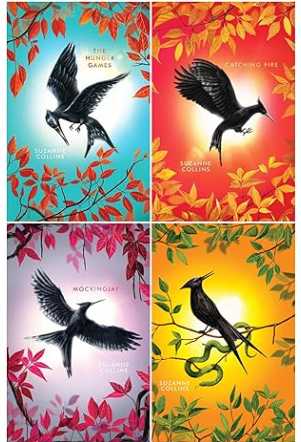
*this post contains affiliate links


These books were the first YA books I ever read, and they are still in my top favorites. I’ve re-read this series more than any other series to date! I understand not liking the violent content, but I think every single person needs to read these books to understand certain aspects of being human. Thank you for posting your review, I enjoyed reading your thoughts!